Sunday, March 26, 2017

A Matter of Selection


1.There are many prominent features relating to the variation of the plant species Brassica Oleracea. These plants varied in color, plant size, length, width, leaf size, and the stem’s length and width. As I walked around the garden, I examined the leaves color and texture rather than any other factors. I believe these have a higher level of variation within the species. I took my time looking at every single leaf from each and every plant. Our plant the Brussels sprout has thick luscious leaves that have variations of a refreshing green coloring and a soft white vein appears on each leaf's surface. In my observations plant A (Kale) has a different texture and color. Its leaves were stiff and dark colored, and it’s veins made different patterns on the leaf’s surface. Kale has bumpy edges on its leaf and its color is more like a dark green almost like turquoise, although these plants are from the same species they vary. This is why natural variation is so cool because when observing the plants you can find little differences that make that plant unique. Those genetic changes make a difference but they will always be the same species. 


2.Ever wondered why plant species have so much variety? Thanks to artificial selection and other factors, a plant species can branch out into different varieties of the same plant. A wild plant goes under a different type of selection. Natural selection comes into play when the plant isn’t being cared for by a human. In other cases, many humans love to take care of their plants. Since they are cared for, they can change certain factors that can change the plant in a plethora of ways. In those cases humans cross-breed their plants to obtain a certain trait. These traits can make the plant superior to any other type of plant. The processed is called artificial selection. Artificial selection allows those specific traits to be passed down to future offspring which is useful in so many cases. This has made Brassica Oleracea so diverse and a dominant plant species.


3.I noticed a main trait within the species, it was the stems size. The stem seemed to have the same thickness. The height of the stem itself obviously varies with each plant. However the thickness is very consistent. I measure the diameter of the stem it was about 1 or 1.3 cm thick. I believe their common ancestors had thick stems as well. It appears to be very dominant in the Brassica Oleracea. I concluded maybe they have this thick stem to make the plant more stable and durable to all certain types of weather and climates, if the thick stem is dominant in this species this means that the diameter of the stem is very important.


4.In order for scientists to engineer a plant to have a thick stem, they need to genetically change and test the seed. They would need to inject or cross-breed with the desired genes that code for the thick stemmed traits. This would reassure that the plant would have those traits because cross breeding or injecting the desired gene will for sure make a dominant thick stemmed gene to appear on the phenotype.

Friday, March 3, 2017

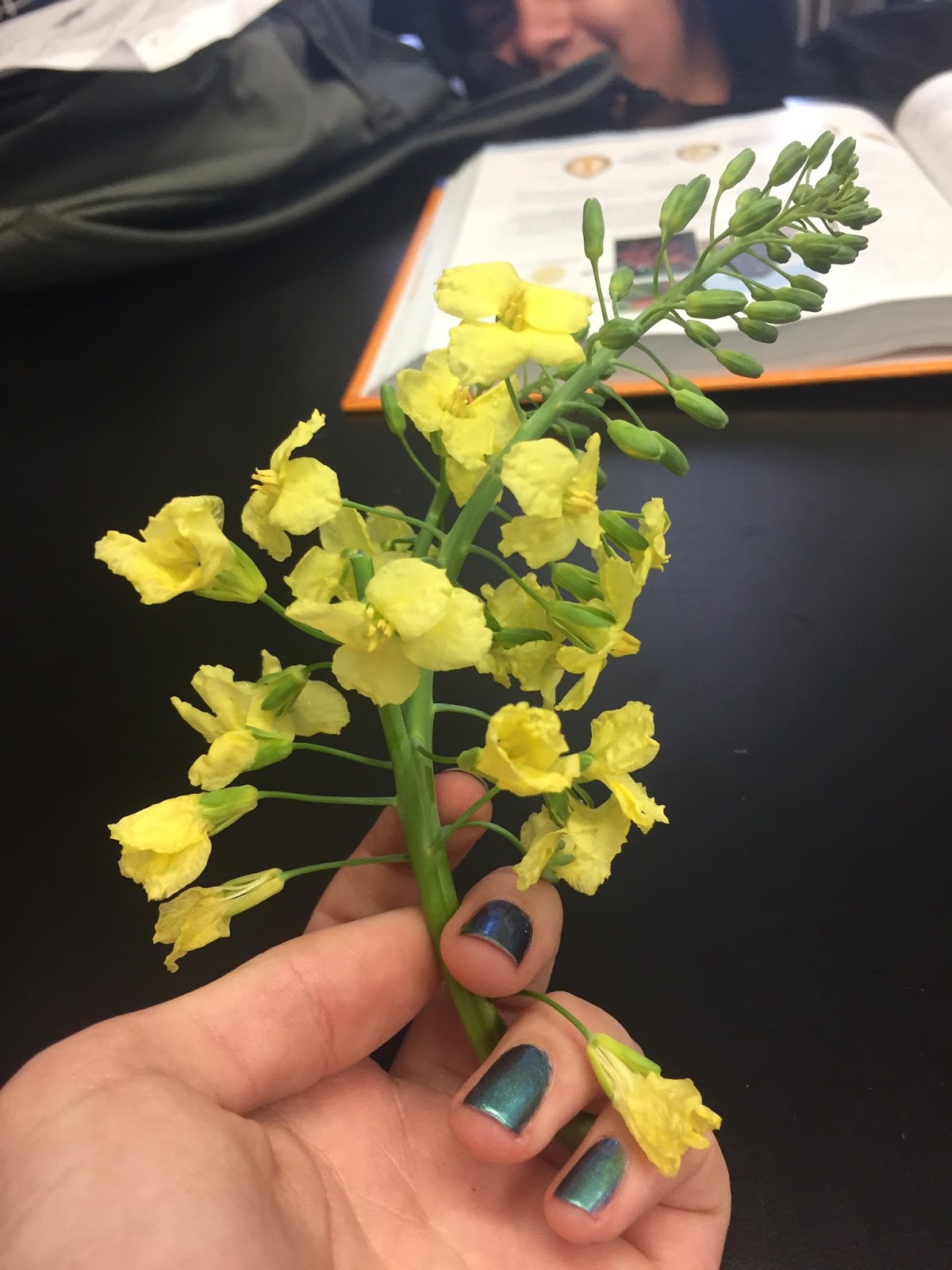
This yellow flower is a big part of the brassica Plants because it makes them Healthy, These small flowers have a strong reproductive system,there known as angiosperms.


This is the male reproductive system of a flower, the stamen hold a strong and very important role.they make the male gametes and while examining the stamen are full with pollen.


Brassica Flower Dissection

This yellow flower is amazingly beautiful.they are a big part of the garden and they help the Brassica plants be healthier.These little flowers have an amazingly fast reproductive system,and they are known as angiosperms.Angiosperm is a consistent part of male and female parts in the same organism.Which means that these flowers reproduce quick.

This a photo of male reproductive anatomy.The anthers hold a strong a very important role.They make the male gametes and while examining the anthers they are loaded with pollen


This photo is of the we are looking at the female reproductive anatomy of the flower.If u look really close you can see this part as the carpel.The carpel is also called a stem.At the very top you can see the stigma.Since the stigma is very sticky some pollen grains end up sticking on the the stigma.

Thursday, February 16, 2017

Brassica Flower Dissection


An angiosperm is basically a flower plant and it makes seeds. In the certain parts of the plant like the anatomy contains ovules and pollen, which contain sex cells. Like any other sex cell it is produced by the process of meiosis. The pollen contains the sperms cells they are formed inside the anthers. The pollen transfers to the stigma of another plant and it goes under pollination. Then the sperm cell transfers down to the ovary where it fertilizes the ovules. Once that process is done one of the ovules will develop into seeds.

These yellow flowers are beautiful! They form an amazing part of the garden and they make the Brassica plants healthy.  These little flowers have an astonishing reproductive system, and they are known as angiosperms. What is an angiosperm you may ask? It consist of both male and female parts in the same organism.Which means that these flowers have the ability to reproduce on its own.


In this photo we are taking a look at the male reproductive anatomy. These are the anthers they hold an important role as well. They make the male gametes (sperm cells) and while examining the anthers they are loaded with pollen.


      In this photo we are looking at the female anatomy of the flower. If you look closely we are can identify this part as the carpel. The carpel is a stalk that is also called a style. At the top of the picture you can see the top called the stigma. Since the stigma is very sticky some pollen grains end up sticking on to the stigma.


Sunday, January 22, 2017

My plant has grown alot since i had last checked on it. And its all thanks to photosynthesis, Mitosis, and cell respiration. Last time i had looked at our plant it had faded its green a little bit and also gotten a bit bigger. I think the fading of the green is due to the weather or climate. What a plant needs to grow is photosynthesis, The rotation of carbon dioxide and oxygen.

The plant uses enzymes to process photosynthesis. They are used to convert sunlight into much needed energy. The enzyme is pretty much what makes the plant make the ribosomes into proteins. When the enzymes PEPC and Rubisco are done, They are sent to the Golgi for the transformation.


Thursday, January 19, 2017

How Does Your Garden Grow?


 1.     Our Brussel sprout plant has grown rapidly, although the process is slowing down. Last time I checked our plant has lost a little touch of its green color. Some of the leaves on the bottom of the stem have turned yellow due to the climate change I believe. Although the sun comes out I think our plant isn’t receiving the correct amount of sunlight for the process of photosynthesis. Photosynthesis is very much needed for the plant to grow in biomass, the process absorbs carbon dioxide from the atmosphere and it turns it to oxygen which allows the plant to grow. The plant continues to use the oxygen and glucose produced, the plant goes under a process of cellular respiration to create energy, water, and oxygen. After cellular respiration mitosis begins within each cell. The cell division produces new cells and this allows our plant and any other plant to grow.


2.      Any plant uses enzymes to go under photosynthesis. The enzymes are very much needed to convert sunlight into energy that can be used in the plant. A plant needs to understand the enzymes when the sign enters the nucleus the Ribosomes begin to build the proteins. This enzyme isn’t just any enzyme its a special type of protein. Lastly, when the enzymes PEPC and Rubisco are complete, they are immediately sent to the Golgi apparatus for the transportation.


Tuesday, December 20, 2016

Story of the seed stories

The story of seed was a slow journey and it can be interpreted in many ways. Each and every group had their own opinion and own experience. Josiah was on team 6, and he had an exciting and amazing experience. He learned many things from just growing a simple cabbage plant. He learned the purpose of soil and nutrients they include. He understood why a plant needed so much special attention, and how many factors can effect the growth rate of the plant. Josiah was amazed with the study of competition and biotic and abiotic factors. He didn't know that plants had competition just like humans for jobs and other placements. Plants are effected by many factors like the temperature conditions, soil conditions, placement conditions, and the amount of light the plant needs. Josiah enjoyed working with his team they embarked many funny conversations but at the same time they worked quickly. In the end Josiah made deeper connections with the growing process. In the beginning Josiah thought the plant growing was simple and easy just a little bit of water and sunlight and there you go. Josiah was wrong and he thinks differently now he knows the process is very intense and these plants need special care. In the end I asked Josiah if he would ever consider planting again, he responded with "Yes plants are cool and amazing they are so extravagant!" He really liked the story of the seed experience he said it was great!


Wednesday, November 2, 2016

Some abiotic factors a plant depends on are soil water and how much sunlight and water it gets.
Some biotic factors it depends is where it is paced becuase some areas are more populated in ways that can kill the plant.
The plant can be engaged by other plants by both wanting the same abiotic source such as land or food.
The winners are the ones that live and the losers are the ones that die. When you cant tell who wins or who loses, You have to see who is doing better.
Interaction can either mess things up or boost things in a way.
There are aot of signs making it seem like we have succsesion becasuse there are alot of other plants around it. But we noticed it is close to starting to die.
This seems like secondary succsesion.


Saturday, October 29, 2016

An Ecological Analysis of the Garden and our Plants


    The garden is exposed to certain factors, just like any other ordinary ecosystem. Our plants are exposed to certain Abiotic and biotic factors and these element have affect on our garden and on the plants. Examples of Abiotic that involve the growing of the plant are the climate, precipitation, consistency of the soil, sunlight, and pollution surrounding it.  These are the factors that are non-living and they consist in any ecosystem. There are also Biotic factors and they are living factors can have some change in how our plants grow. Competition of other plants growing around the garden, bacteria, insects, and maybe some animals. These are biotic factors that can have an affect on the garden.


   The plants In the garden can be in competition with many things surrounding it. Things that a plant competes with the soil they both want nutrients they both need certain nutrients. Usually growing plants involves weeds growing they compete with each other for water the space that is given.  They also compete for the amount of sunlight that is given during the day. Competition can be any where and it can be very crucial for the plants growing in those surrounding areas.

  It's not sure who really wins are loses in these types of cases because sometimes it can be uncertain. There is no clear cut of winning and losing this is caused because sometimes half and half.


The plants are interacting with much of their surroundings and they are interacting with each and every cycle. They interact with the whole environment that surrounds it. Like the air quality, human interaction, or any interaction with any type of species. The affect on the plants can depends sometimes they can be positive sometimes they can be negative. The way we can find out is see how the garden and the plants react to their surroundings.


  Succession has a lot of say in this, there is two types of succession, primary and secondary. Primary is where its a new fresh start of an area where it begins to create new vegetation and etc. Secondary succession is where new vegetation is growing after a natural disaster like a fire or like an area that once had vegetation. I believe the garden seems like secondary succession because during the summer it was almost exposed to the dryness of the drought and as well there use to be old vegetation growing there from previous plantings.


 I hope to observe more of the plants in the garden to maybe come back and correct my answering incase of different results while analyzing the garden over the year.

Friday, October 28, 2016

Biogeochemical Cycles and Our Plants


After the first few weeks, our plant has made its way to being a beautiful green leafy plant. When we  observed our plant we noticed some changing factors. We have concluded that it  has grown much more than it was before it was placed in the garden. We can say the overall appearance of the plant has became bigger and the leaves are broader. With the help of the water cycle our plant looks healthy and very much alive. A plant needs water to grow it is very important, the water cycle introduces itself to a plant and the plant does its part to help the cycle continue. Our plant has used its water to grow, it takes it in from them soil using the roots and the water travels up the roots and usually stored in the central vacuoles of all the cells that make up the plant itself. The Carbon cycle is also introduced to plants in the garden,  the plants in the garden have run the biological carbon cycle using the process of photosynthesis to convert Carbon dioxide into carbon-rich carbohydrates and certain sugars to feed themselves. They not only feed themselves, also they make oxygen as a byproduct of photosynthesis. and elements essential for all life.  The nitrogen cycle also plays a factor in a plant’s life. After all plants are producers, and the plants sooner or later will eventually be consumed by biotic force. Eventually, the plants die and they produce wastes that contain nitrogen.  So During decomposition , these nitrogen compounds get decomposed by bacteria in the soil, releasing  them back to the cycle.


Sunday, September 11, 2016

Brief Bio

My name is Edward Ledezma. I am originally from San Jose, California born and raised.

I have planted before with my mom and my two older sisters, my mom knows a lot about gardening. My mom always knows how much water and how much sunlight her plants should get. She makes sure that her plants are well maintained. I guess I have cooked a couple of times but it was nothing to serious or complicated like pouring milk into bowl of yummy cereal . Although, my mom does  know how to cook and she makes some good food, she always has made delicious stuff for me and my family. In a one whole summary, planting has been around me for a long time and cooking is out of the picture except for that bowl of cereal.

Friday, September 9, 2016

Brief Bio

My name is Trevor Millett. I am originally from Texas. I have lived there for 10 years then moved here with my parents ans some friends. I have tried to sustain a plant containing food but it never worked out for me. So i would like to make a blog about me trying to make something like this.

Brief Bio

My name is Genesis Fernandez. I am originally from California, San Jose. I was born here in 2002 with my mom, dad, my older brother, and with my youngest brother along the way. I have garden before but it wasn't quite a plant that was edible, it was more like just a normal plant. Additionally, I have garden a set of trees for my old elementary school and it was a blast! It made our school look more beautiful.

My lovely mother has been in love with plants, she grows them mostly in pots and she has grown some spearmint in a small piece of dirt in front of our apartment complex. She began with a little succulent and she placed it in front of our door. My mom has done many plantings and she has helped many of her friends plant herbs in their garden.  Gardening is something that will always be present in my life and it's nice watching plants grow and observing their nature. I especially love photosynthesis, I have done many science experiments on that specific topic. In general planting is cool and I'm really excited to continue analyzing this seedling project.

Wednesday, September 7, 2016

Brief Bio

My name is Jaido Uribe. I am originally from San Jose,California.I moved to San Jose when i was a baby.My grandparents live here in San Jose there and we go there every day.


I have gardened before with my mom and my sister.I have cooked once with my dad for my mom on her birthday.My mom is good at cooking i love all of the food my mom makes it is always amazing.When i lived in Tracy we gardened in our back yard we grew tomatoes and lettuce.My favorite thing to do is eat our ripe tomatoes.But we moved and we stopped with gardening and have not since we lived in Tracy.